
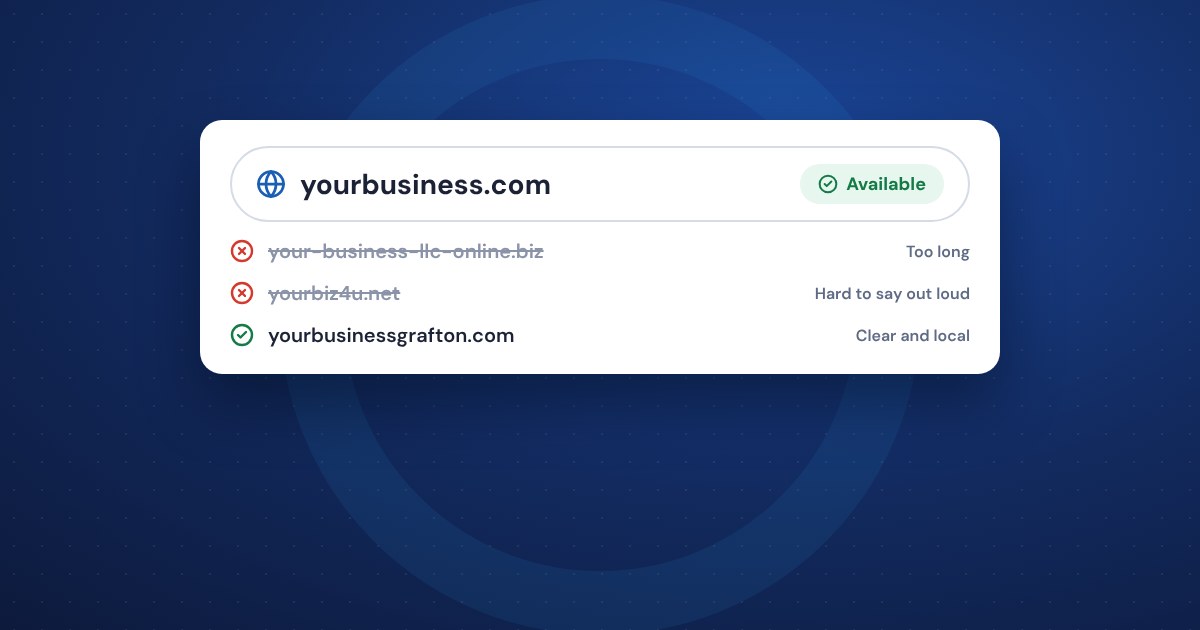
The best domain name for most small businesses is your business name, as a .com, short enough to say over the phone without spelling it out. Then register it in your own name, turn on auto-renew, and keep the login somewhere safe. That last part matters more than most owners realize.
Start with your business name
Your domain is your web address and, in most cases, your email address too. You'll put it on your truck, your invoices, your business cards and every email you send. The simplest choice is usually the right one: the name customers already know you by.
If your full business name is long, shorten it in a way that still sounds like you. "Smithandsonsplumbingandheating.com" is hard to type. "Smithplumbing.com" is easier, if it's free. Adding your town can also work, like "graftonbakery.com", especially if you only serve one area.
Make it easy to say, spell and remember
Try the phone test. Say the domain out loud to someone and ask them to type it. If you have to explain it, keep working on it. A few things that cause trouble:
- Hyphens. People forget them, and "smith-plumbing.com" sends some of your customers to "smithplumbing.com", which may belong to someone else.
- Numbers. Is it "4" or "four"? Customers won't know.
- Odd spellings. "Kwik" and "4u" look clever on a sign and get lost in email addresses.
- Double letters where two words meet, which are easy to mistype.
- Length. Shorter is better, but clear beats short.
Before you buy, have someone who wasn't part of the brainstorm read it written out in lowercase. Words run together online, and a perfectly innocent business name can spell something embarrassing once the spaces are gone. Better to find out now than after the van is wrapped.
You can show your domain with capital letters on signs and business cards to make it easier to read, like SmithPlumbing.com. Domains aren't case sensitive, so it still works however people type it.
Pick .com if you can
Most people still assume a business website ends in .com. If someone hears your name and types it from memory, that's where they'll go. Get the .com if it's available.
There are good reasons to use something else. A nonprofit is usually expected to use .org. A business outside the US may want its country's extension. In those cases, also register the .com if you can and point it at your main site, so people who guess wrong still find you.
Newer extensions like .co, .shop or .biz work technically, but customers often type .com by habit. If you go that way, make sure you're comfortable sending some traffic and email to whoever owns the .com.
Brand name or keywords?
Some owners want a domain stuffed with search terms, like "bestroofingmilwaukee.com". It's tempting, but the domain name alone does very little for your Google rankings today. What helps is useful content, a well-built site and a solid Google Business Profile. A keyword domain can also box you in if you expand to new services or new towns.
A branded domain grows with you and builds recognition every time someone sees it. For most businesses, use your name. If you want help with the part that actually moves rankings, start with search engine optimization.
If the name you want is taken
It happens a lot. Your options:
- Try a small variation: add your town, your trade or a word like "get" or "shop" in front.
- Check whether the domain is actually in use. If it's parked or for sale, you can make an offer, though expect to pay more than a normal registration.
- Look up the registration details to see when it expires. Some domains are released if the owner doesn't renew, but don't count on it.
- If someone registered your trademarked name to profit from it, talk to an attorney. There are formal dispute processes, but they take time and money.
Whatever you choose, register it soon. Names that are free today may not be next month.
Register it in your name and turn on auto-renew
This is where small businesses get burned. A web designer, an employee or a relative registers the domain "to save you the hassle", and years later nobody has the login, or it's in the name of someone who has left. When the domain lapses, your website and your email stop working at the same time.
Protect yourself:
- Use a well-known registrar and make sure the account is in your name or your business's name.
- List yourself as the owner and use an email address you will always have access to. Avoid an address on the same domain, since you can't get those emails if the domain stops working.
- Turn on auto-renew, and keep the payment card on file current.
- Turn on two-factor login for the registrar account.
- Store the login in a password manager, and make sure one other trusted person can get to it.
- Turn on the registrar's privacy option if it's offered, so your personal details aren't public.
It's fine for your web designer to manage the domain. They should do it with access you grant, not in an account you don't control. Also check renewal prices, not just the first year. Some registrars offer a cheap first year and charge more after that, and many push add-ons a small business doesn't need.
The short version
- Use your business name, as a .com, if you can get it.
- Pass the phone test: easy to say, spell and type, with no hyphens or numbers.
- Have a fresh pair of eyes read it in lowercase before you buy.
- Register it in your own name, with auto-renew and two-factor login turned on.
- Keep the login somewhere safe that someone else you trust can reach.