
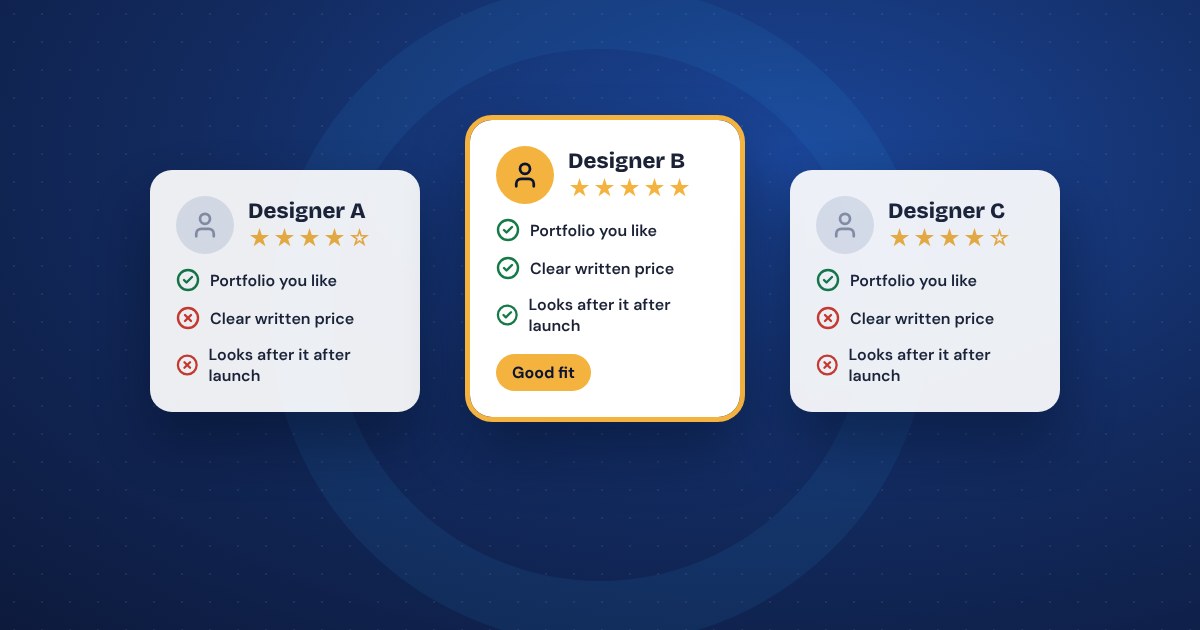
Pick a web designer who asks about your business before talking about design, explains things in plain English, puts the site and domain in your name, and has a clear plan for after launch. Price matters, but those four things decide whether you are still happy with the decision two years from now.
Know what the site needs to do first
Before you call anyone, write down what you want the website to do. Get more phone calls? Take bookings? Sell products? Answer the same ten questions your staff answers every day? A site for a plumber and a site for an online store are very different projects, and a good designer will price and plan them differently.
Write down a few sites you like and why, a few you don't, and a rough budget. You don't need a technical brief. A one-page list helps you compare designers on the same terms and stops the project from growing every week once it starts.
Look at their work, then talk to them
Ranking first on Google means a designer is good at their own marketing. It doesn't tell you much about the sites they build. Ask other business owners whose websites you like who built them, then look at portfolios.
When you look at past work, check it on your phone, not just a laptop. Many of your visitors will see your site on a phone. Click around. Is it fast? Can you find the phone number in a few seconds? Would you trust that business?
Then have a real conversation. Pay attention to who asks the questions. A good designer wants to know who your customers are, how you make money and what success looks like. If the call is all about colors and animations, or you hang up confused by jargon, keep looking. It's their job to explain things so they make sense to you.
Make sure you own the site and the domain
This is the part most owners skip, and it causes the most pain later. Before you sign, get clear answers on:
- Who registers the domain, and whose name is on it. It should be your name or your business, in an account you can log into.
- Who owns the hosting account, or at least whether you get full admin access to it.
- Whether you get admin logins to the website itself, not just an editor account.
- Who owns the custom design, photos, logo and written content once you have paid.
- What happens if you part ways. Can you take the site to another provider without paying a fee or starting over?
Some parts of a site are licensed, not owned. Most websites run on software, themes or plugins that you use under a license. That's normal. The contract should spell out what is yours and what is licensed, in language you understand.
Ask what happens after launch
A website is not done on launch day. Software needs updates, backups need to run, and your hours, staff and services will change. Ask every designer you talk to:
- Can I make simple text and photo changes myself? Will you show me how?
- Who handles updates and security, and what does that cost per month or per year?
- How fast do you respond if the site goes down?
- Do you keep backups, and can I get a copy?
There's no wrong answer between doing it yourself and paying for a maintenance plan. The wrong answer is not knowing who is responsible until something breaks.
Red flags to walk away from
Most designers are honest. These signs usually mean trouble anyway:
- They register the domain in their own name and won't change it.
- They won't give you admin access to a site you've paid to own. On a monthly plan where the provider makes all changes, limited access can be normal, as long as you know up front what you get if you leave.
- Every answer is full of jargon, and they get impatient when you ask what it means.
- They promise first place on Google, or guaranteed traffic by a certain date. Nobody can promise that.
- The quote is one line with a number. You can't tell what is included or what costs extra.
- No contract, or a contract that says nothing about ownership, timelines or what happens if you leave.
- They have no recent work to show, or won't tell you who the sites belong to.
- They are hard to reach before you've paid. It rarely gets better after.
Compare quotes on scope, not just price
Quotes can vary a lot for what sounds like the same site. Line them up and check what each one includes: number of pages, who writes the content, whether basic search setup is part of it, mobile testing, training and the first months of support. A cheap quote that leaves out content and support often ends up costing more.
Ask for a timeline with milestones, and ask what they need from you and when. Delays on the client side, waiting on photos and text, are the most common reason projects drag.
Last, trust your gut. You may work with this person for years. If they are easy to talk to and honest about what they don't do, that counts for a lot. If you want to see how we approach it, our website design page lays out what's included.
The short version
- Decide what the site needs to do before you talk to anyone.
- Judge designers on their questions and how clearly they explain things, not on their Google ranking.
- Get the domain in your name, and know what you own and what access you get, before you pay.
- Know exactly who handles updates, backups and fixes after launch.
- Walk away from guarantees, vague quotes and anyone who won't hand over access.