
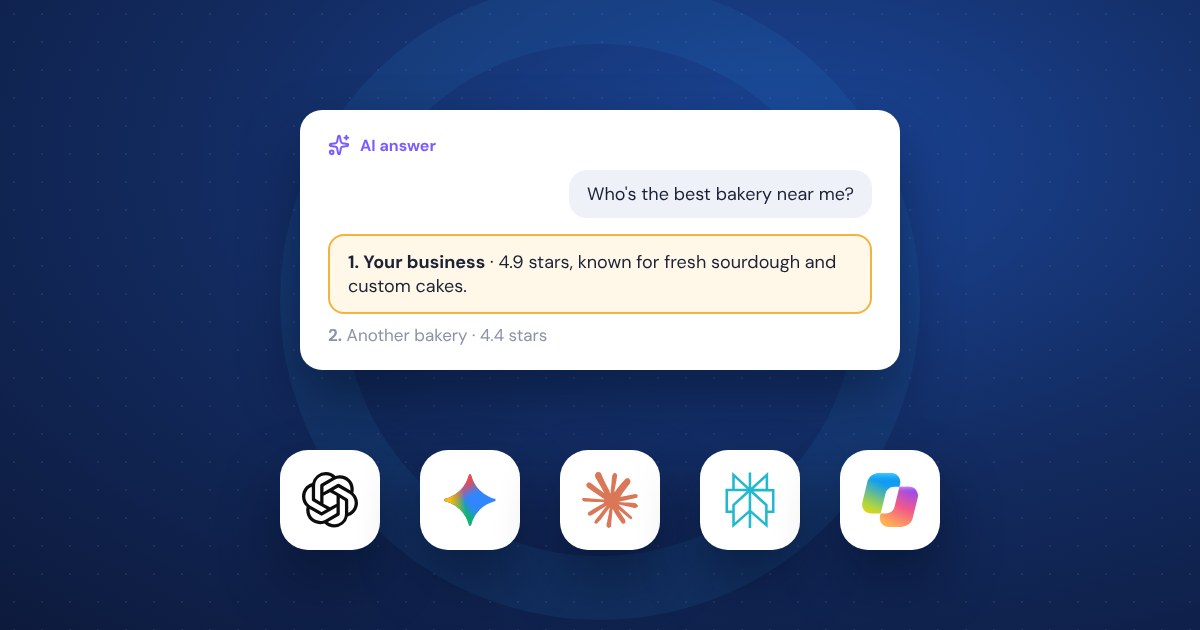
Answer engine optimization (AEO) is making sure AI tools like ChatGPT, Gemini and Google's AI Overviews can find accurate information about your business and are confident enough to mention you when someone asks for a recommendation. It isn't a replacement for SEO. It's built on the same foundation, with more weight on clear facts, consistent details and what other sites say about you.
How AEO differs from SEO
Traditional SEO aims to get your page into a list of ten links. The customer clicks, reads and decides. With an AI answer, the tool does the reading and gives the customer a short answer, often naming two or three businesses. If you're not in that short answer, the customer may never see you.
That changes a few things:
- The answer is a summary, so the tool needs facts it can state plainly: what you do, where, for whom, and how you compare.
- AI tools lean heavily on other sources: review sites, directories, local news and "best of" lists. Your own website is one voice among many.
- There's no single ranking to track. The same question can get a different answer tomorrow, or a different answer in ChatGPT than in Gemini.
What hasn't changed: the tool still has to find you, read your site and trust what it reads. A site that does well in Google is usually in a much better position for AI answers too. Google says plainly that there are no extra requirements to appear in AI Overviews or AI Mode beyond normal search best practices.
How AI tools find and choose businesses
Most AI answers about local businesses come from a search the tool runs in the background. ChatGPT search, for example, uses OpenAI's own crawler, OAI-SearchBot, to find pages. Google's AI answers draw on Google's search index and on Business Profile information. Then the tool reads what it found and writes a summary.
When you ask "who's a good web designer near Milwaukee" or "best HVAC company in Ozaukee County," the tool is looking for a few things:
- A clear match. Does this business actually do the thing, in that place?
- Agreement between sources. If your website, Google profile, Yelp page and a local directory all say the same thing, the tool can repeat it with confidence.
- Outside proof. Reviews, ratings, and mentions on lists and directories the tool already trusts.
- Plain, quotable text. A sentence like "We repair and replace furnaces in Grafton, Cedarburg and Mequon" is easy to use. A slogan isn't.
For many local and service searches, AI answers lean on third-party lists, directories and review sites more than on the businesses' own websites. Being on the sites AI reads matters as much as your own site.
What helps
The short list of what makes a real difference:
- Clear facts on your website. Your services, the towns you serve, your hours, your prices if you publish them, and who you work with, written in plain sentences.
- Consistent details everywhere. The same business name, address and phone number on your site, your Google Business Profile, Bing, Apple Maps, Yelp, Facebook and industry directories.
- Reviews. A steady flow of recent, detailed reviews on Google and the review sites that matter in your industry.
- FAQ-style content. Pages that answer the questions customers actually ask, one question and one direct answer at a time.
- Mentions on trusted sites. Industry directories, chamber listings, local news and "best of" lists.
- A site AI tools can read. Pages that load, text that isn't buried in images, and a robots.txt file that doesn't block the crawlers you want.
Structured data, the hidden code that labels your business name, address and services for machines, is worth having and keeping accurate. Google asks that it match what's visible on the page. Just don't expect it to work magic on its own.
Our step-by-step guide to getting recommended by AI walks through each of these in order.
What doesn't help
AEO has attracted a lot of quick fixes. Most of them waste money.
- Special "AI files." Google says you don't need new machine-readable files, AI text files or special markup to appear in its AI features.
- Stuffing pages with questions. A wall of fifty thin FAQs reads as filler to people and to machines.
- Keyword-stuffed business names. On Google, it breaks the rules and can get your profile suspended.
- Fake reviews or paid mentions on junk sites. Platforms remove fake reviews, and a mention on a site nobody trusts carries little weight.
- Writing for robots. If a sentence sounds strange to a customer, it won't help with AI either.
- Chasing FAQ snippets in Google. Google stopped showing FAQ rich results in search in May 2026. FAQ content is still useful for readers and AI tools, but the special search display is gone.
One more thing that hurts: blocking AI crawlers by accident. Some security plugins and hosting setups block bots broadly. If OAI-SearchBot can't read your site, OpenAI says your pages won't appear in ChatGPT search answers.
How to check how you show up today
You don't need a paid tool to get a baseline. Spend twenty minutes on this:
- Ask ChatGPT, Gemini, Copilot and Google's AI Mode the questions your customers would ask. "Best [your service] in [your town]." "Who does [specific job] near [your area]?"
- Note who gets mentioned, and which sources the tool cites. Those sources are where you need to be.
- Ask each tool directly about your business. "What does [your business name] do?" Check whether it gets your services, location and hours right.
- In Google Search Console, traffic from AI Overviews and AI Mode is included in your normal search performance report, so watch that for changes.
Save your questions and answers in a document. Run the same check every month or two. Answers move around, so look for trends, not single results. If you'd rather have someone run the check and fix the gaps, that's what our AI search optimization work covers.
Common questions
Is AEO the same as GEO or AI search optimization? Mostly, yes. People use answer engine optimization, generative engine optimization and AI search optimization for the same idea: showing up in AI-written answers.
Do I need to stop doing SEO? No. Strong SEO is the base AEO is built on. Most of the work overlaps.
Can anyone guarantee I'll be mentioned by ChatGPT? No. AI answers vary from one question to the next and change over time. Anyone promising a guaranteed spot is guessing.
The short version
- AEO is about getting named in AI answers, not just ranked in a list of links.
- AI tools trust consistent facts, real reviews and mentions on sites they already read.
- Good SEO is still the foundation. There's no secret file or code that does it for you.
- Check what AI tools say about you today, and repeat the check every month or two.